
Authors: Ungyu Lee, Minho Park, Li Jiao, Li Li, Yue Zhang, Xue Bai, Yongbin Xu, and Nam-Chul Ha
Why we focused on albumin binding
- Peptide therapeutics can be powerful, but many are cleared rapidly from the body, often requiring strategies that extend their circulation time.
- Serum albumin is an attractive endogenous carrier because it is abundant in blood and benefits from FcRn-mediated recycling.
- Common half-life extension strategies, including lipidation, Fc fusion, and direct albumin fusion, can be effective but may add chemical complexity, steric bulk, or very tight binding.
- Our goal was to design a compact, genetically encoded albumin-binding module with moderate affinity and rapid, reversible dissociation rather than persistent binding.
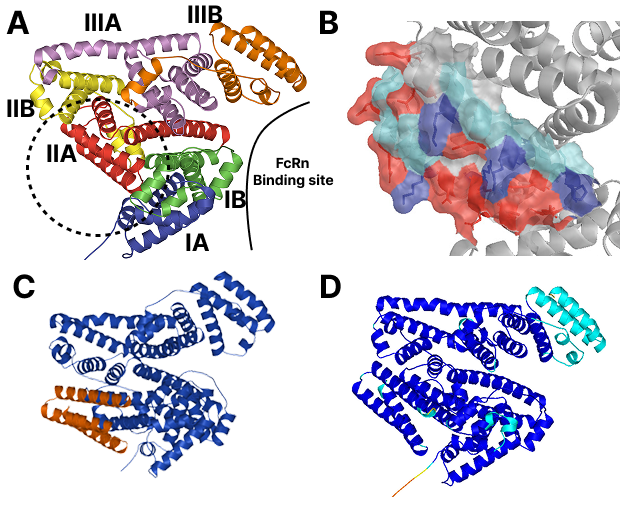
Figure 1. HSA Domain II was selected as the design target, and AlphaFold2 predicted ABD257 to bind the selected HSA surface with high structural confidence.
Design concept: compact binder, moderate affinity, reversible exchange
- We targeted a surface in human serum albumin (HSA) Domain II, while avoiding known FcRn interaction regions.
- The designed interface was enriched for polar and charged interactions to favor reversible binding behavior.
- The lead design, ABD257, is an approximately 8 kDa three-helix miniprotein, making it much smaller than conventional Fc or albumin fusion partners.
AI-driven design pipeline
- RFdiffusion generated 10,000 candidate HSA-binding miniprotein backbones.
- Candidates were filtered for the intended three-helix scaffold and target-surface engagement, reducing the pool to 50 backbones.
- ProteinMPNN designed five sequences for each selected backbone, producing 250 sequence-structure candidates.
- AlphaFold2/AlphaFold-Multimer was used to evaluate predicted HSA-miniprotein complexes, leading to four lead candidates: ABD257, ABD2874, ABD5528, and ABD6681.
- Five replicate 200 ns molecular dynamics simulations were then used to compare interface stability and interaction features before experimental validation.
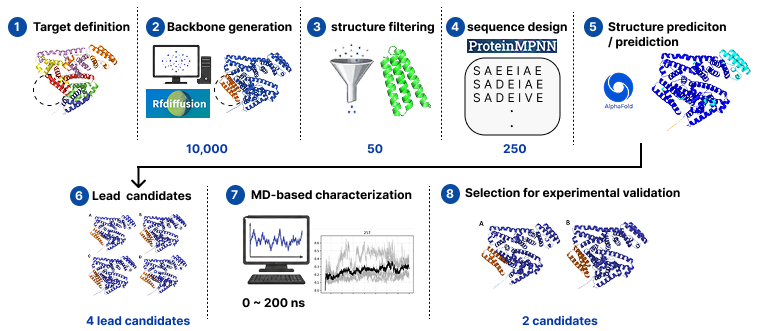
Figure S1. AI-driven workflow for designing and selecting HSA-binding miniproteins.
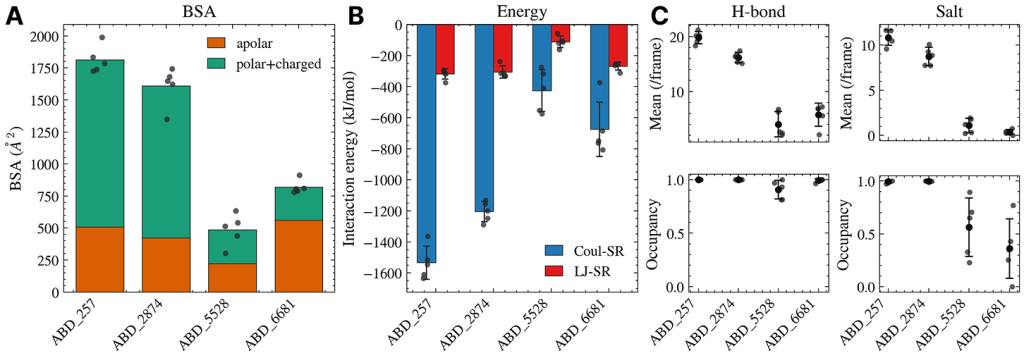
Figure 2. MD simulations compared interface size, interaction energies, and polar contacts across designed miniproteins.
Experimental validation of albumin binding
- Size-exclusion chromatography followed by SDS-PAGE showed that ABD257 and ABD2874 co-eluted with HSA, supporting complex formation in solution.
- ABD257 was prioritized for deeper characterization because it combined favorable MD-derived interface features with clear SEC co-elution behavior.
- Biolayer interferometry showed rapid, reversible association and dissociation of ABD257 with HSA.
- For HSA, ABD257 showed a kinetic KD of 159.8 nM, with kon = 3.87 x 10^5 M^-1 s^-1 and koff = 0.062 s^-1. The steady-state KD was 180.7 nM.
- For mouse serum albumin (MSA), ABD257 bound more weakly, with a kinetic KD of 1.56 uM and a similarly rapid koff of 0.0619 s^-1.
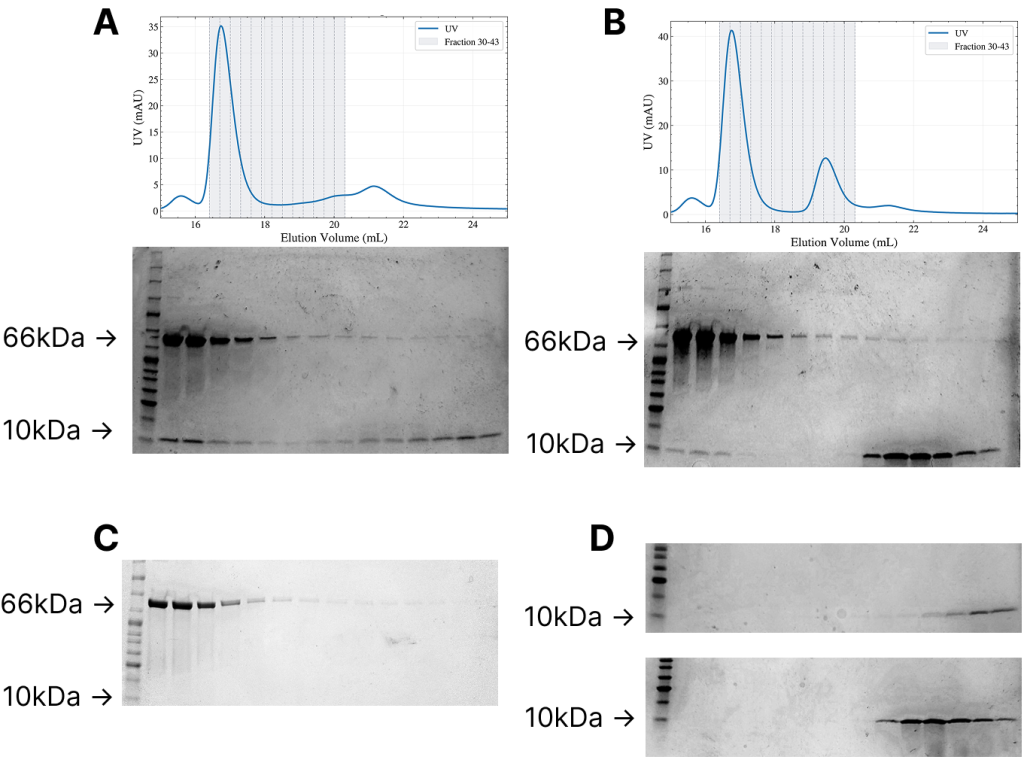
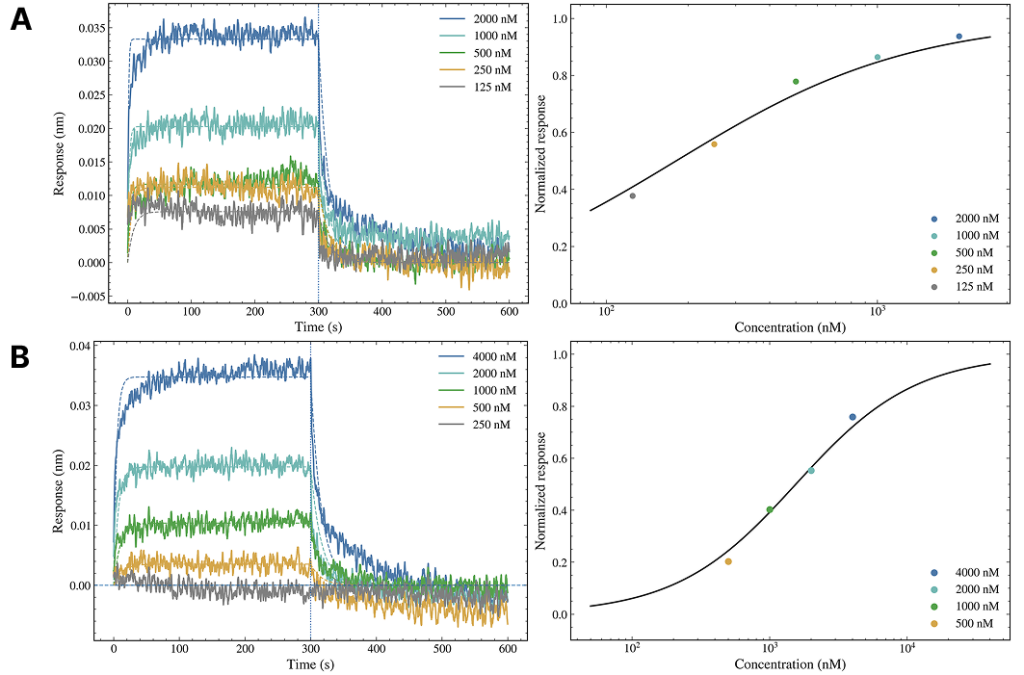
Figures 3-4. SEC co-elution and BLI confirmed rapid, reversible albumin binding by ABD257.
Application: extending the activity of mtGLP-1
- To test therapeutic applicability, ABD257 was genetically fused to a protease-resistant mutant GLP-1 analog, mtGLP-1, through a flexible GS linker.
- The fusion protein was recombinantly expressed in E. coli using a ProTalpha solubility tag, followed by TEV cleavage to generate active mtGLP-1-ABD257.
- In a cell-based GLP-1 receptor assay, mtGLP-1-ABD257 retained receptor activation potency, with an EC50 of 0.095 nM compared with 0.156 nM for unfused mtGLP-1.
- These results indicate that the compact ABD257 module did not substantially interfere with the GLP-1 receptor-activating function of the payload.
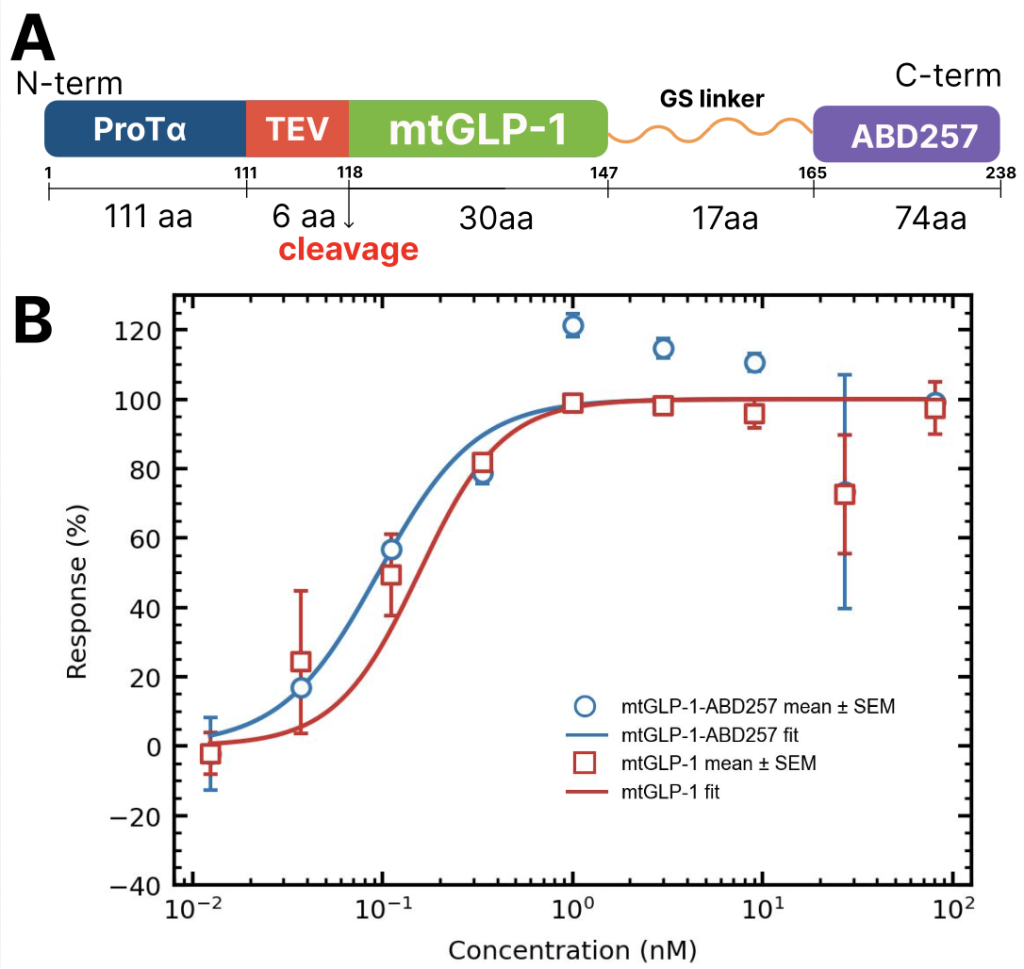
Figure 5. ABD257 was fused to mtGLP-1 through a flexible linker, and the fusion retained GLP-1 receptor activation potency in cells.
Mouse pharmacodynamic results
- In an acute oral glucose tolerance test, both mtGLP-1 and mtGLP-1-ABD257 reduced glucose excursion compared with vehicle-treated controls.
- In a delayed oral glucose challenge, mtGLP-1-ABD257 still reduced glucose excursion when the glucose challenge was administered 6 h after dosing.
- In ad libitum-fed mice, unfused mtGLP-1 showed a rapid glucose-lowering effect but began to rebound after approximately 1 h.
- By contrast, mtGLP-1-ABD257 maintained a more sustained glucose-lowering profile over the 5 h observation period and showed a lower late-phase glucose AUC from 2 to 5 h.

Figure 6 and Figure S6. mtGLP-1-ABD257 preserved acute glucose-lowering activity and showed a more sustained pharmacodynamic profile than unfused mtGLP-1 in mice.